
Ingestion & Data Foundation
Prism tables, source feeds, base datasets, schema alignment and controlled ingestion from Workday and external systems.
Workday Prism Analytics
Trinayana designs Workday Prism solutions across ingestion, transformation, enrichment, publication and lifecycle management—connecting Workday and external data while preserving lineage, usability and operational control.
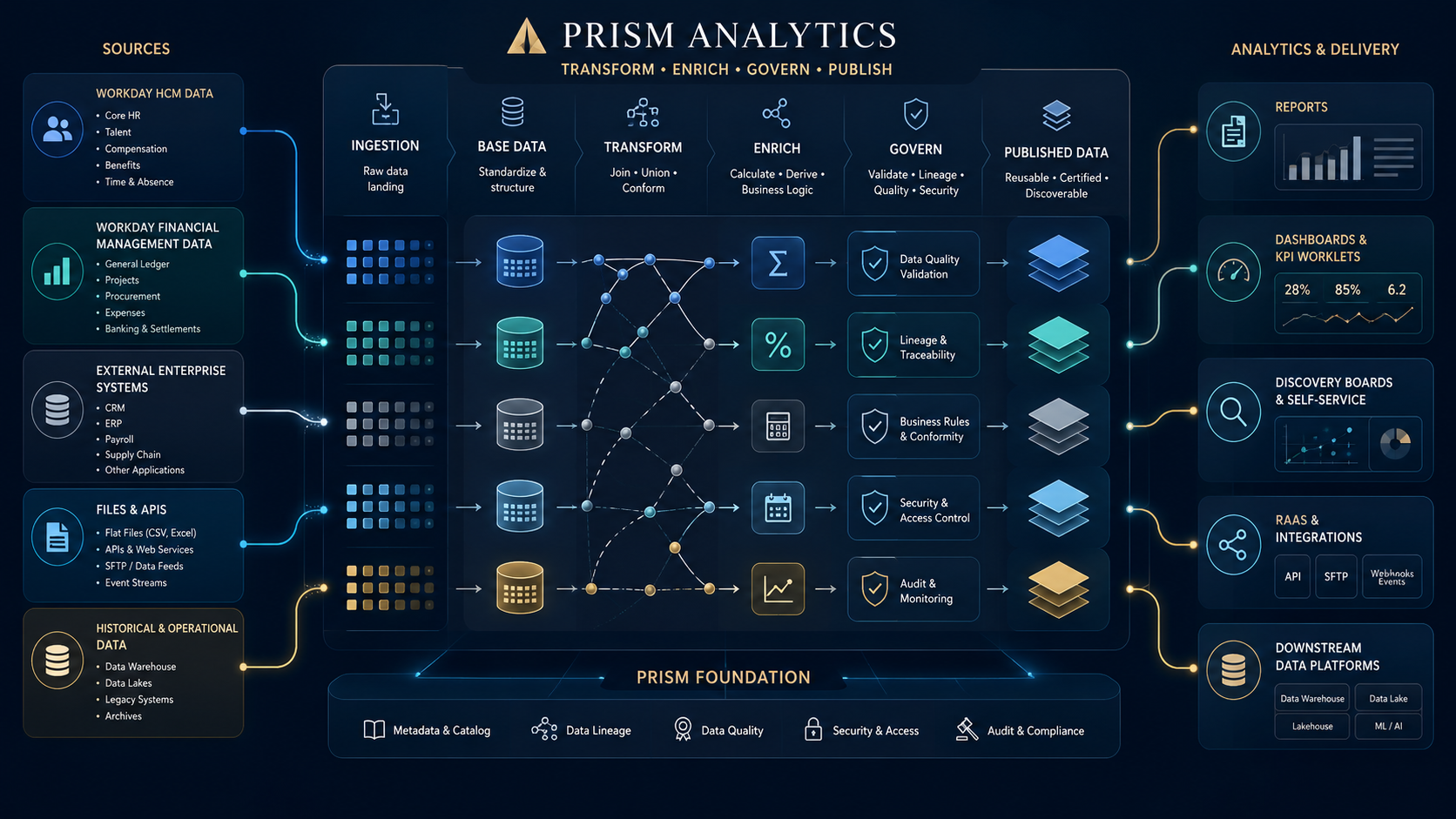
Prism architecture
A sustainable Prism solution must preserve source meaning, transformation logic, lineage and downstream usability as new data, schemas and reporting needs are introduced.
Prism tables, source feeds, base datasets, schema alignment and controlled ingestion from Workday and external systems.
Derived datasets, pipelines, calculated logic, joins, unions, anti-joins and reusable transformation stages.
Combine different systems and schemas while preserving source distinctions, shared attributes, traceability and downstream reporting meaning.
Trace fields from source through transformation and publication using count reconciliation, mapping checks, data-type validation and lineage review.
Reporting-ready data products
Prism becomes more valuable when transformed data is published as a reusable product rather than rebuilt separately for every report, dashboard or integration.
Create consistent published sources for enterprise, operational and domain reporting.
Support dashboards, KPI worklets and Discovery Boards with reusable, governed data.
Use published sources for RaaS, integrations and downstream enterprise-data consumption.
Prism operational control
Prism solutions continue to evolve after deployment. Data growth, schema changes, object dependencies, failed transformations and reporting mismatches require disciplined lifecycle management and evidence-based remediation.
Use insert, update and delete Data Change Tasks for controlled maintenance, retention, correction and scheduled operations, with automation enabled through Workday Orchestrate or integration patterns where appropriate.
Identify high-growth tables, define practical retention boundaries, preserve required history and reduce unnecessary active volume.
Sequence tables, datasets, pipelines, Data Change Tasks, mappings, reports and dependent objects across tenants, followed by lineage and output validation.
Investigate missing, duplicated or excluded records, broken joins and unions, data-type issues, failed Data Change Tasks, stale tables and reporting mismatches.
Controlled maintenance, retention, migration and remediation across complex, high-volume Prism environments.
How Trinayana engages
Review sources, schemas, tables, datasets, pipelines, publications, dependencies and lifecycle risks, then define a focused roadmap.
Deliver a defined ingestion, transformation, published-data, reporting-foundation or complex-remediation outcome.
Support high-volume operations, migration assurance, automation planning and continuing Prism architecture decisions.
Representative experience reflects delivery performed by Trinayana’s Principal Architect. Client names, source-system identifiers and proprietary implementation details are excluded.
Start with one Prism priority
Share the ingestion, transformation, lineage, migration, reporting or lifecycle issue that needs clearer ownership. Trinayana can help define a governed and supportable path forward.
Discuss a Prism Priorityuma@trinayana.com