
Source & Schema Readiness
Assess layouts, field definitions, accounting attributes, data quality and schema readiness before downstream design.
Workday Financial Data & Accounting
Trinayana provides architect-led ownership across the complete Workday financial-data chain—from source schema, inbound integration and Prism transformation through Accounting Center, journals, reporting, outbound delivery, reconciliation and validated business outcomes.
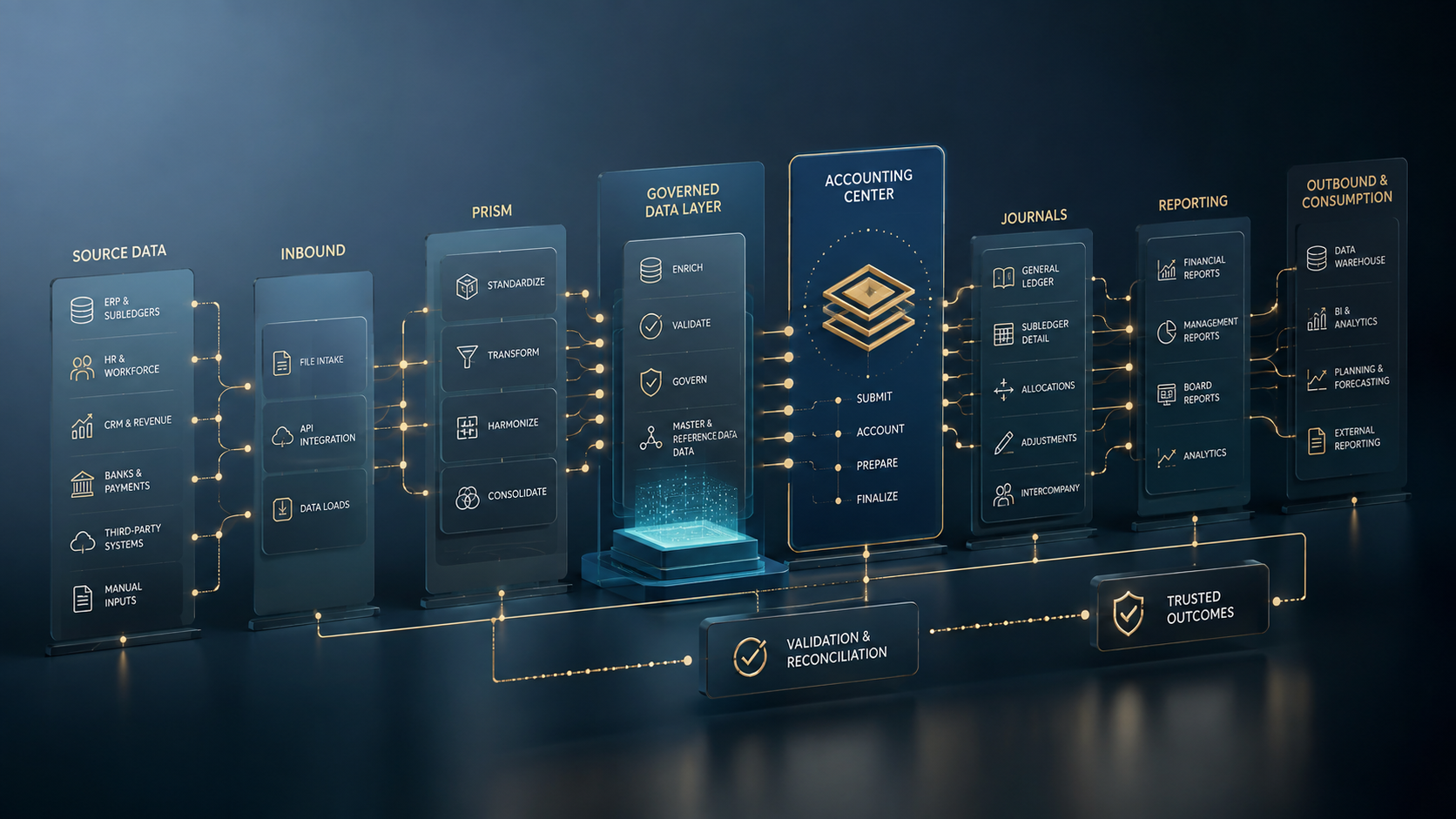
End-to-end solution ownership
Complex Accounting Center solutions depend on source structure, ingestion, Prism transformation, accounting processing, reporting, outbound delivery and reconciliation operating as one traceable design.
Assess layouts, field definitions, accounting attributes, data quality and schema readiness before downstream design.
Design reliable Studio, EIB, RaaS, API, SFTP and file-based ingestion patterns.
Build governed ingestion, enrichment and reporting layers using datasets, pipelines, joins, unions, calculations and Data Change Tasks.
Align Accounting Sources, attributes, mappings, rules, summarization and balancing behavior with the intended accounting result.
Deliver detailed, summary and combined reporting together with governed downstream financial data.
Compare source, transformed, journal, report and outbound results to establish traceability and business-ready evidence.
Accounting Center architecture
Accounting Center becomes difficult when source structure, Prism transformation, accounting behavior, reporting and downstream requirements are designed separately. Trinayana connects these decisions so the accounting result remains traceable through the complete data chain.
Align source schema, accounting attributes, Prism architecture, Accounting Source requirements, processing, reporting and downstream delivery for a new financial-data stream.
Support Accounting Events, Business Events and Pre-Accounted patterns while preserving source distinctions, reusable structures and shared reporting requirements.
Investigate attributes, mapping logic, posting conditions, summarization, suspense or offset behavior, balancing outcomes and source-specific journal generation.
Trace journals and reporting results backward through Accounting Center, Prism lineage and source data to validate accounting behavior and business meaning.
End-to-end delivery experienceSource schema and Prism transformation through Accounting Center, reporting, outbound delivery and validation.
Accounting Source evolution
After Accounting Center goes live, clients often need new source attributes, reporting dimensions or additional feeder systems introduced into an architecture that already supports historical data and posted journals. Trinayana traces each change through the full source-to-outbound lifecycle while protecting established processing and reporting.
Add new attributes to an established Accounting Source while protecting existing processing, historical continuity, journal behavior and reporting dependencies.
Expand a shared source model using a governed superset schema, source-specific population rules and consistent downstream processing.
Identify affected schemas, Prism objects, Accounting Center configuration, reports, outbound mappings and consumers before implementation.
Validate established and revised files, source systems, batches, journals, reports and outbound integrations to confirm prior functionality remains intact.
Financial Prism architecture & lifecycle
Financial Prism architecture must preserve field meaning, lineage, accounting readiness and reporting usability while remaining operationally sustainable as journal, reporting and audit-supporting data accumulates.
High-volume Accounting Center and Prism environments can accumulate years of source, journal, reporting and operational data. Trinayana helps define practical retention rules and implement controlled data reduction without disrupting current accounting or reporting operations.
Identify high-growth tables, historical accumulation, downstream dependencies and approved retention candidates.
Design candidate datasets and Delete Data Change Tasks using stable load identifiers, timestamps and controlled execution boundaries.
Confirm candidate counts, executed deletions, remaining records, load completeness and reporting continuity.
Move from controlled manual execution to scheduled automation with sequencing, dependency checks, empty-input safeguards and monitoring.
Controlled deletion across high-volume Accounting Center-related Prism tables in Production using approved retention logic, staged execution and post-delete validation.
Typical needs include contracted-capacity management, active tables retaining several years of detailed data, downstream-preserved history and manual purge processes requiring repeatable automation.
Complex remediation & delivery proof
Accounting and reporting symptoms often originate several stages earlier. Effective remediation traces the issue across reports, outbound data, journals, Accounting Center, Prism lineage and source records.
Trace source-specific accounting behavior, transformations, conditions, summarization, journals and reporting results to isolate the point of failure.
Assess source-layout changes, new attributes, routing requirements, outbound mappings and downstream-consumer dependencies.
Structure high-volume operations into controlled batches or ranges, monitor execution, validate residuals and document the outcome.
Source schema and Prism transformation through accounting, reporting, outbound delivery and validation.
Controlled deletion across high-volume Accounting Center-related Prism tables in Production using approved retention logic, staged execution and post-delete validation.
Large source, ingestion, reporting and combined data layers supported through governed design and validation.
Financial data protected through engineered masking, supplemental transformation logic and validation.
Representative experience reflects delivery performed by Trinayana’s Principal Architect. Client names, source-system identifiers and proprietary implementation details are excluded.
How Trinayana engages
Review the source-to-accounting landscape, risks, dependencies and control gaps, then define a focused roadmap.
Investigate a defined Accounting Center, journal, balancing, reporting or source-to-journal issue and provide evidence-based direction.
Support a new source, feeder system or attribute expansion across schema, Prism, Accounting Center, reporting, outbound delivery and regression validation.
Address high-volume retention, controlled data reduction, complex remediation, migration assurance and key financial-data architecture decisions.
Start with one financial-data priority
Share the source, accounting, reporting, outbound or reconciliation issue that needs clearer ownership. Trinayana can help trace the complete flow and define a controlled path to a validated outcome.
Discuss a Financial Data Priority